
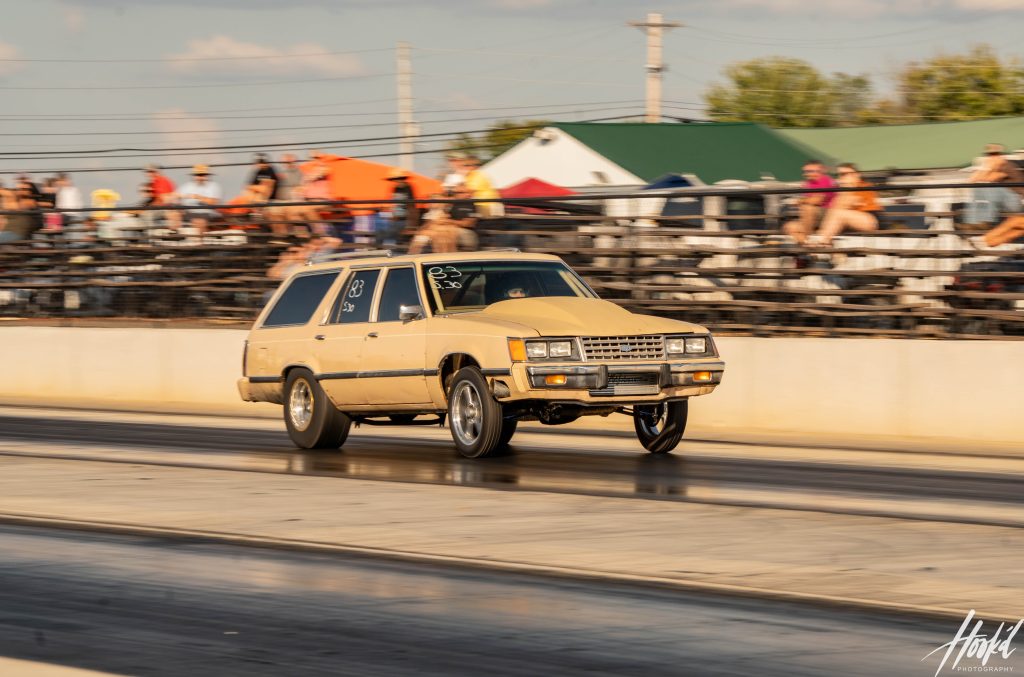
Photo by Hook’d Photography
When an enthusiast decides to transform a bulky 1983 Ford LTD Wagon into a high performance drag machine, the challenges loom large. For Dustin Steward, this was not a textbook build. Every twist, every setback, every success was earned. His strength emerged not from having perfect resources, but from adapting, learning, and leaning on a community that believed in his vision.
The Reality of Limited Resources
Dustin never claimed to have deep pockets. His approach from day one was to make the most with what he had. He hunted for deals on Facebook Marketplace. He waited for holiday discounts. He reused parts where it made sense. Every dollar had to count. In a field where some builds see six figure budgets, his was a test in resourcefulness.
Because he already owned a folder of Mustang parts, those components became the framework for his conversions. Rather than waiting for brand new Ford pieces, he adapted what was available. Many people dream of perfect blueprints. Dustin had raw parts, trial fits, and improvisation. That constraint became a strength, not a weakness.
Fabrication Trials and Learning Curves
When it came time to build suspension mounts, brackets, firewall modifications, and mini tubs, Dustin encountered a steep fabrication learning curve. His experience in sheet metal and welding was modest, and many parts required custom trimming, tabbing, gusseting, and alignment work.
One of the most challenging tasks involved the mini tubs from Detroit Speed & Engineering. Installing tubs of that scale inside a full-size wagon forced Dustin and his crew to rethink wheel clearance, shock mounts, axle path, and driveshaft angles all inside a tight envelope. Every cut had to be precise. Every weld had to avoid distortion. Mistakes were costly. Some panels were trimmed, patched, rewelded. Through it all he learned the hard way what real shop work feels like.
The roll cage, though built by a specialized shop (Tony Jewel Fabrication in Hamersville Ohio), still required interface brackets, mounts, and integration with original structure. That meant collaboration and careful measurement. Everything had to fit.
The Role of Trust and Collaboration
One of the hidden strengths of Dustin’s build was support from friends, his twin brother Dylan, and fellow enthusiasts. No one part of the car was built in isolation. The project became a group effort. Someone would help mock up a bracket. Another would help weld on a subframe connector. Another would drive to fetch parts or assist late at night.
By leaning on this community, Dustin avoided doing every single job himself. That let him prioritize critical path items. He coordinated with the tuning, the engine shop, and the cage fabricators. He gave up control when necessary and trusted others to execute. That trust saved time, avoided burnout, and improved quality.
Tuning Restraint and Strategy
With a massive turbo and strong internal components, the temptation to crank boost high is ever present. Dustin resisted. Early tuning was conservative to preserve engine and drivetrain longevity. He used E85, which gives flexibility and safety margin under load. The turbo, a G57 frame 88 mm unit from On 3 Performance, was sized to allow headroom so the engine could grow. With Bob Morrison of Morrison Tuning guiding the calibration, the approach was methodical rather than reckless.
That conservative tuning at early stages paid off. It prevented detonation, component stress, and surprises. It allowed the drivetrain to be tested, the cooling to be evaluated, and weak links to be identified without catastrophic failure.
Time, Patience, and Setting Boundaries
Part of the challenge was time. Between work, life, and project demands, there were nights when fatigue set in, when fabrication mistakes happened, or when momentum stalled. But Dustin accepted those real limitations. He paced the work. He set boundaries. He took breaks. He prioritized safety.
That patience also extended to milestones. He did not rush to make a pass. He waited until systems were solid. He tested slowly. He double checked everything before first fire up. That disciplined attitude reduced blowups and costly setbacks.
Emotional Growth and Resilience
Building something unique always invites criticism or doubt. Many people asked why he would put a Chevy heart in a Ford body. Some Ford purists shook their heads. Others assumed it was a folly bound to fail. Dustin did not always wave the hood open at shows. He let the results speak for themselves.
Each time the wagon ran well, each time the timer lit up, each time the build overcame a hurdle, his confidence strengthened. He developed patience, respect for detail, humility about what he didn’t know, and grit to push through frustration. The project evolved him nearly as much as it evolved the car.
The Value of Reflection
Looking back, Dustin would tell you the journey was not just about speed. It was about project ownership. It was about doing something no one else would do. It was about testing limits, failing and bouncing back, learning fabrication, tuning theory, mechanical integration, and relationships with helpers. It was about making mistakes, owning them, and improving.
That kind of build becomes more than a car. It becomes a statement. A testament. A story. It becomes a map of growth, of passion, of audacity.
When the wagon finally hit 5.23 seconds in the eighth mile at 137 miles per hour this year at Edgewater Sports Park, it was not just a number on a slip. It was proof that the vision, the sacrifice, and the collaboration added up to something real. It was evidence that ambition backed by consistency can topple expectations.
Dustin’s build is far from finished. But every obstacle he overcame, every misstep, every late night, every friend who lent a hand, they became part of the narrative. And that narrative invites others to step off the beaten path, to experiment, to adapt, and to build not only with parts, but with heart.
Connect with us

